
On 27 June 2026, an event was held at the North Brighton Community Garden in Tarndanya on Kaurna Country (Adelaide, South Australia). This was sponsored by the Community Garden and the local City Council (local government level). Neil Jones, a Community Garden member and an URI Individual Member (one of over 2500 in 122 countries!), assisted in the planning and helped facilitate a multifaith community attendance through his involvement with the Interfaith Matters! Forum.
The clear, sunny day commenced with a Community Planting event in the adjacent biodiversity garden (urban pocket park) which is an ecosystem restoration project aimed at increasing local native plant species and diversity. This was the second year of planting, which is timed to coincide with winter rainfall and cooler temperatures, and was again coordinated by the Council Urban Greening Officer. Just under 500 plants, consisting of native grasses, lilies, small shrubs, and ground covers, were carefully introduced into pre-augered holes under Council staff guidance and tuition, the planting community displaying impressive collaboration and coordination.
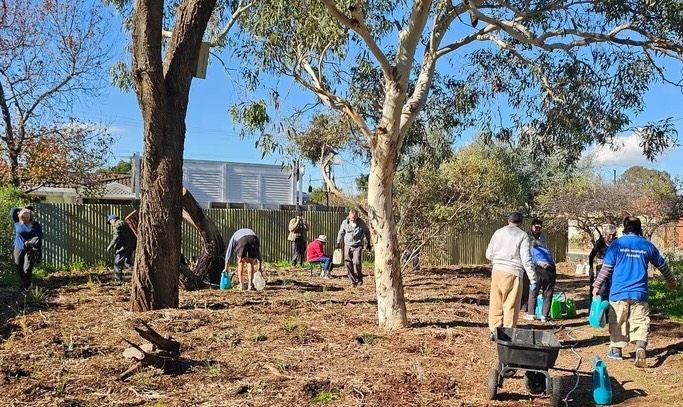
Planting local native species in the Biodiversity Garden
It was then time for lunch in the Community Garden where members had researched and prepared an impressive array of dishes prepared from seasonal, fresh produce much of it sourced from the Garden. The diverse offerings included eggplant fritters, spinach gozleme, sweet potato and daikon curry, “Longevity” soup (cooked in solar ovens), Persian fritters known as “koukou”, baked pumpkin with yogurt and tahini, a variety of dips, homemade and sourdough bread, blood orange marmalade and tomato relish. The Garden is renowned for its desserts and the mandatory lime cake, whole orange cake, chocolate and tahini biscuits, and refreshing fruit salad were demolished in rapid time.

After lunch, we had the privilege of hearing from Garry Goldsmith in the biodiversity garden. Garry, a Narungga man, discussed with us with a range of First Nations perspectives including the importance of relationships with one another and with our natural world and their value in overall wellbeing. He also described how the harmful algal bloom deeply impacts the Narungga people and their cultural ties with the butterfish. In his capacity as co-Chair, Garry updated us on the newly formed Southern Australia Aboriginal Land and Sea Management Alliance (SAALSMA) and the importance of ecosystem restoration.
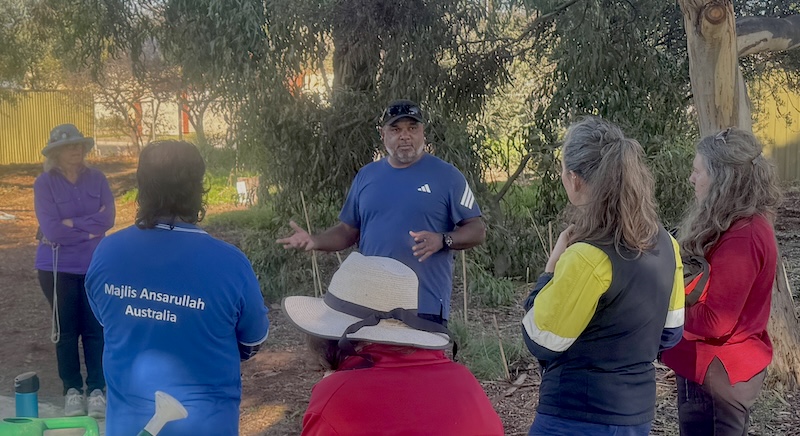
Garry Goldsmith (co-Chair of SAALSMA) discussing First Nation peoples’ perspectives and wisdom
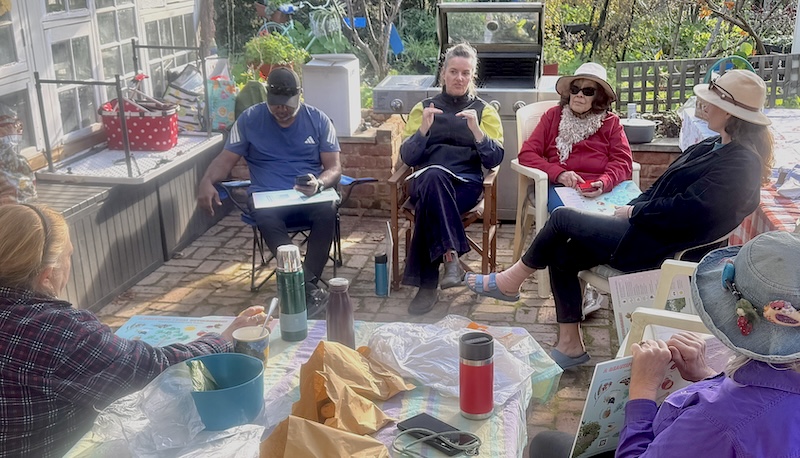
Garry then led an informal panel discussion alongside local experts Emma Sandery and the Council Urban Greening Officer, covering the topics and practical aspects of sustainability initiatives in our local community, Indigenous wisdom, and ecosystem restoration and biodiversity.
In life, good things often lead to other good things. We were very pleased to welcome five members of the local Ahmadiyya Muslim Community (Noor Mosque) to the event.

Members of the local Ahmadiyya Muslim Community with Neil Jones at the Community Garden
The Ahmadiyya Muslim Community is a very peaceful, law-abiding, nonviolent and loving community. Founded in 1889, the Community spans more than 200 countries with membership exceeding tens of millions. The Ahmadiyya Muslim Community is the leading Islamic organisation to reject terrorism in any form categorically. Similarly, the Ahmadiyya Muslim Community is the only Islamic organisation to endorse a separation of mosque and state. Today, it continues to be an advocate for universal human rights and protection for religious and other minorities. It champions the empowerment and education of women. Its members are among the most law-abiding, educated, and engaged Muslims in the world. In 2018, The Ahmadiyya Muslim Association South Australia purchased the Uniting Church congregation which was being sold in Morphett Vale. Subsequently, Uniting Church place of worship was converted into Noor Mosque and continues to be a beacon of recognising God. Some feedback from the community members about the Community Garden event were:
"I would like to say thank you to Neil Jones for inviting me to the North Brighton Community Garden. It was a great gathering which signified unity. The food was very delicious and I had tried solar cooked food for the first time. Thank you."
- Farooque Ahmed Chandio
"Thank you and it was nice meeting you all. It was a good gathering and good food."
- Bashir Ahmed Chandio
"Tree plantation was great and I am proud to have planted a few trees in the North Brighton Garden and the food was so good."
- Rana Akram

The local Ahmadiyya Muslim Community organized a community seminar and lunch on 11 July as part of NAIDOC (National Aboriginal and Islanders Day Observance Committee) Week and some members of the Community Garden were delighted to attend this important event.

Solar thermal box (left) and parabolic (right) cookers
The solar thermal ovens generated some interest and awe amongst the attendees and is an example of how the sun’s rays can be directly and easily harnessed in a very sustainable and natural way to undertake one of humanity’s most important and socially binding tasks: cooking! On this note, Neil and URI member, Anne Aisatullin, are helping Luther Krueger organize an online Earthwide Solar Cooking Festival and Conference which will be held in September – you are all encouraged to attend. Another URI Individual Member, Grace Chilongo from Malawi, is organising a Panel Discussion at this conference which promises to be very informative.

On 18 July, the Brighton Catholic Parish and the Council Urban Greening Officer coordinated a Native Plant Giveaway on the Parish grounds. On a beautiful day, the event was very well attended by the local community and nearly 1000 plants found a new home.

The Faith Ecology Network (FEN) is also a URI member and an Australian hub for strengthening an interfaith dialogue between science and religion with a focus on advancing ecological consciousness by drawing on First Nations peoples, scientists, community groups and faith traditions for inspiration and guidance (see “Ten Ways” to care for biodiversity). Reflecting on these events above, we see many of these principles in action and this framework serves as a very useful guide for those planning similar community initiatives.
In all this, we are reminded that “good” diffuses in all directions - often rapidly and unpredictably - and we are grateful. As we restore and strengthen interdependent and interconnected relationships with the natural world and each other, we will inevitably see a convergence towards prosociality; (eco)spirituality; indigenous governance perspectives and wisdom; ecosystem restoration and revegetation; self-sufficiency; health and wellbeing; and a thriving of multicultural, interfaith, peaceful and “one-planet” community life.